Food marketing in schools
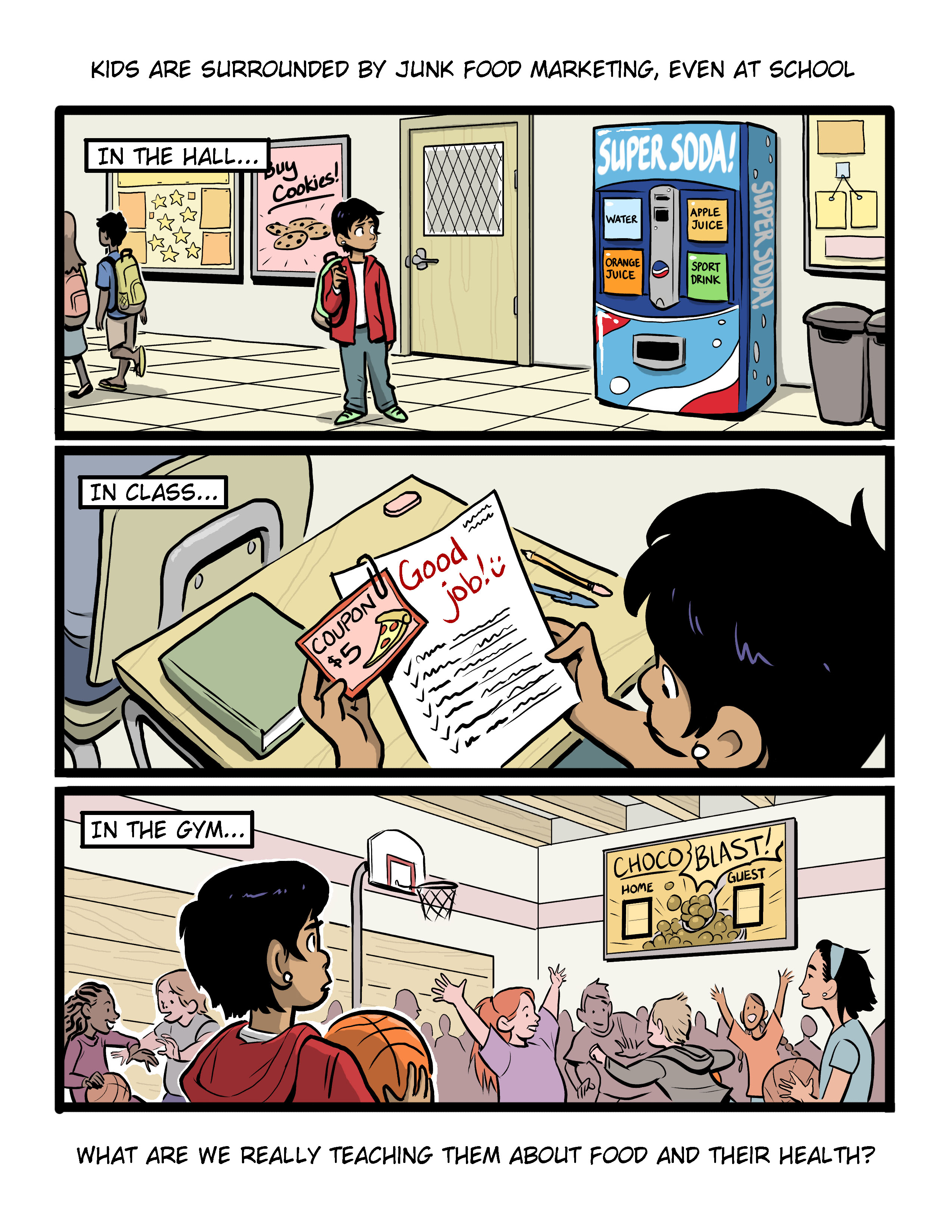
Schools are a key place food, beverage, and restaurant companies market to children. In 2009, companies spent $150 million marketing foods and beverages in elementary, middle, and high schools.1 Logos, brand names, spokes characters and product names are often featured in schools or in conjunction with:2
- Signs, posters, and scoreboards;
- Vending machine exteriors;
- Curricula, textbooks, and other educational materials;
- School equipment (i.e. uniforms, cups, water coolers, beverage cases, food display racks);
- Buses;
- Fundraisers;
- Incentive programs (i.e. pizza coupons given as a reward for reading);
- School discount nights at fast-food and other restaurants;
- Label redemptions programs that provide funds to schools in exchange for consumer purchases;
- Sponsorship of school events, materials, programs;
- Scholarships; or
- Ads in school newspapers, yearbooks, and on school radio stations.
Studies show that labeling and signage on school campuses affect students’ food selections at school.3 This is a problem because many of the foods marketed in schools are of poor nutritional quality.4,5 A national survey found that 67% of schools have advertising for foods that are high in fat and/or sugar.6 Such marketing undermines parents’ efforts to keep their children healthy, which is especially problematic when companies promote the consumption of sugary, fatty foods while kids and youth are away from home and parents are not there to guide their children’s food choices. It also undermines nutrition education.
In 2010, through the Healthy Hunger-Free Kids Act, Congress directed the U.S. Department of Agriculture (USDA) to update and strengthen the guidelines for school lunches and breakfasts, as well as foods sold through vending, a la carte, school stores, fundraisers, and other foods outside the school meal programs. Although schools are making significant improvements to the nutritional quality of the food and beverages sold to children, most schools continue to allow unhealthy foods and beverages to be marketed to them.
Fact sheets, model policies and reports
General/background
Effects of offering look-alike products as Smart Snacks in schools
UConn Rudd Center for Food Policy and Obesity
Don’t Sell Us Short: Tips for effective messaging around junk food marketing in schools
Voices for Healthy Kids
Fact sheet: Marketing of low-nutrition foods and beverages in schools: Reading, writing, and a candy ad?
Center for Science in the Public Interest
Fact sheet: Food marketing in schools: Not “cent$ible” for school funding
Center for Science in the Public Interest
Fact sheet: Restricting junk food advertising on school buses
National Policy & Legal Analysis Network to Prevent Childhood Obesity
Commercialism in U.S. elementary and secondary school nutrition environments: Trends from 2007-2012
Yvonne M. Terry-McElrath, MSA; Lindsey Turner, PhD; Anna Sandoval, MPH; Lloyd D. Johnston, PhD; Frank J. Chaloupka, PhD
Fact sheet: First Amendment: Implications of restricting food and beverage marketing in schools
National Policy & Legal Analysis Network to Prevent Childhood Obesity (NPLAN)
Fact sheet: Developing a healthy beverage vending agreement
National Policy & Legal Analysis Network to Prevent Childhood Obesity (NPLAN)
Copy cat snacks in schools
Cara Wilking, The Public Health Advocacy Institute (PHAI)
Updates to local school wellness policy requirements
Factsheet: Addressing unhealthy food and beverage marketing in schools through local school wellness policies
Voices for Healthy Kids and Center for Science in the Public Interest
Factsheet: Local school wellness policy implementation under the Healthy, Hunger-Free Kids Act of 2010
U.S. Department of Agriculture
Local wellness proposed rule
U.S. Department of Agriculture
Webinar: Food marketing in schools
Food Marketing Workgroup
Policy options for states and localities
Marketing matters: A white paper on strategies to reduce unhealthy food and beverage marketing to young children
ChangeLab Solutions
Model statute limiting food marketing in schools
National Policy & Legal Analysis Network to Prevent Childhood Obesity (NPLAN)
Model school wellness policy
Alliance for a Healthier Generation
Model legislation: Statewide study of food marketing in schools [MS Word]
Center for Science in the Public Interest
Assessment tools
Survey of food and beverage marketing in Montgomery County, MD, schools, plus Assessment Tool [MS Word]
Center for Science in the Public Interest
Food and beverage marketing on California High School campuses survey
Prepared by Samuels & Associates for the Public Health Institute. Authors Lisa Craypo, Sarah Stone Francisco, Maria Boyle, and Sarah Samuels.
Cost/financial implications
Fact sheet on school food funding myths
National Alliance for Nutrition and Physical Activity
Report: School commercialism: High costs, low revenues
Public Citizen. Author Elizabeth Ben-Ishai. Editor Robert Weissman.
Healthy fundraising
Healthy school fundraising fact sheet
National Alliance for Nutrition and Physical Activity
Healthy fundraising ideas
National Alliance for Nutrition and Physical Activity
Healthy fundraising success stories
National Alliance for Nutrition and Physical Activity
Report: Sweet deals: School fundraising can be healthy and profitable
Center for Science in the Public Interest
Healthy fundraising webinar (May 2012)
Center for Science in the Public Interest
Other materials
Did you know these are all forms of junk food marketing in schools?
Voices for Healthy Kids and Center for Science in the Public Interest
What is in-school marketing teaching our kids? A toolkit to create and support healthy learning environments
Voices for Healthy Kids
Illustration: Kids are surrounded by junk food marketing, even at school
Upstream Public Health
Schoolhouse commercialism leaves policymakers behind — Sixteenth annual report on schoolhouse commercializing trends
Molnar A., Boninger F., Libby K.M., & Fogarty J.
Promoting consumption at school: Health threats associated with schoolhouse commercialism — The fifteenth annual report on schoolhouse commercializing trends: 2011-2012
Molnar A., Boninger F., Harris M.D., Libby K.M., & Fogarty J.
USDA’s school nutrition environment and wellness resources website
References
1. Federal Trade Commission [FTC] (2012). A Review of Food Marketing to Children and Adolescents. Follow Up Report.
2. Commercial Activities in Schools. Report No.GAO/HEHS-00-156. Washington, DC: General Accounting Office, 2000.
3. Hastings G. Does Food Promotion Influence Children? A Systematic Review of the Evidence. London, UK: Food Standards Agency, 2004.
4. Center for Science in the Public Interest. Food and Beverage Marketing Survey: Montgomery County Public Schools. Washington, DC: Center for Science in the Public Interest, 2008. Available from: http://cspinet.org/nutritionpolicy/MCPS_foodmarketing_report2008.pdf
5. California Project LEAN. Food and Beverage Marketing on California High School Campuses Survey: Findings and Recommendations. California: Project LEAN, 2006. Available from: http://www.californiaprojectlean.org/docuserfiles//SchoolMarketingReport2006.pdf
6. Molnar A, Garcia DR, Boninger F, Merrill B. A National Survey of the Types and Extent of the Marketing of Foods of Minimal Nutritional Value in Schools. Tempe, AZ: Commercialism in Research Unit, 2006.
